


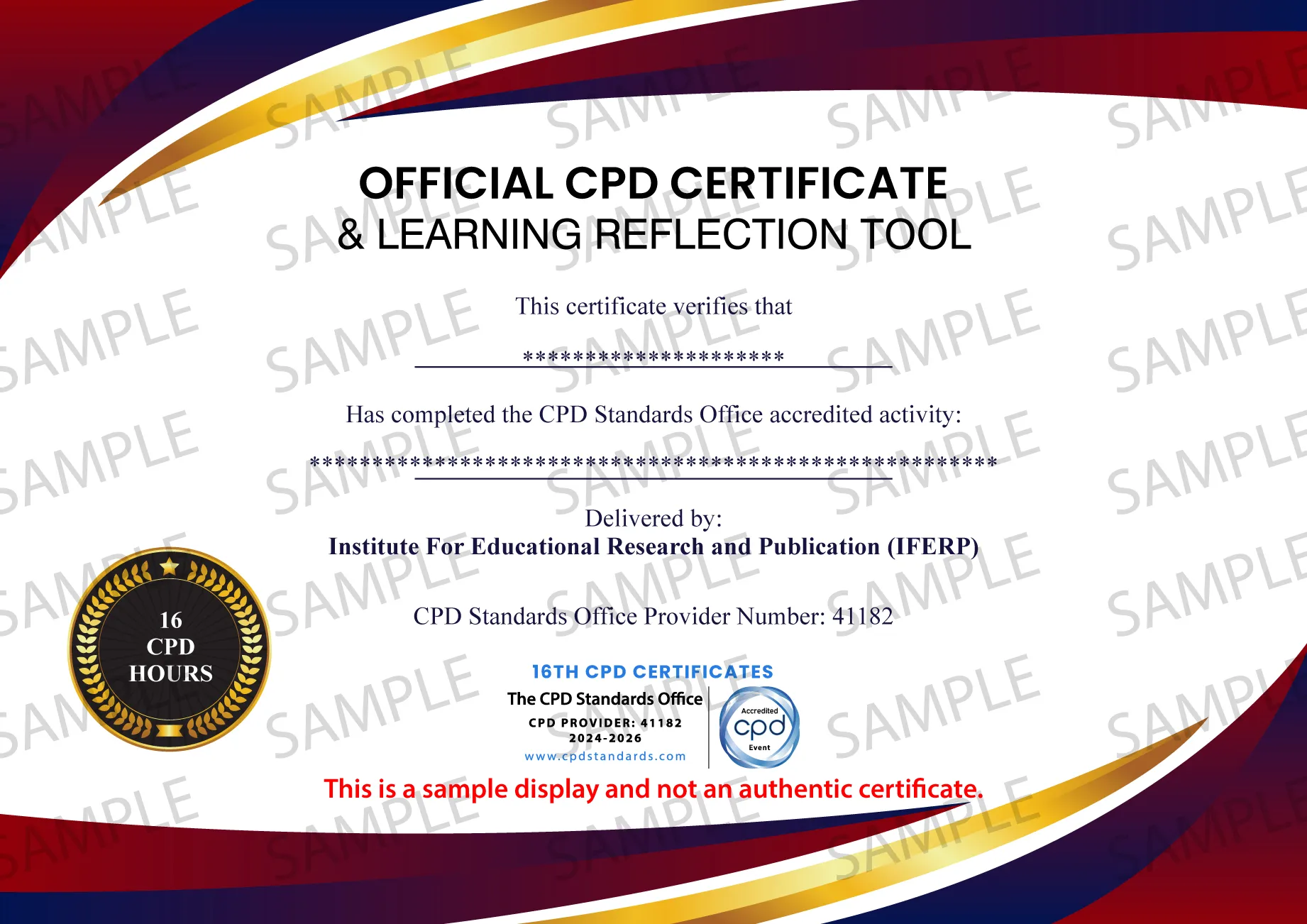
Participate in our conference and receive an official CPD Certificate accredited by the CPD Standards Office (Provider Number: 41182). Enhance your professional development with 16 CPD credit hours, in addition to your conference certificate.
Ans: CPD stands for Continuing Professional Development and refers to the process of maintaining and enhancing your skills, knowledge, and expertise throughout your career.
Ans: CPD helps professionals stay up-to-date with industry trends, improve skills, and maintain competency, ensuring they meet professional and organizational standards.
Ans: CPD points or hours are typically calculated based on the time spent on learning activities. For example, one hour of active learning might equal one CPD point.
Ans: These are learning activities (such as courses, workshops, or webinars) that have been evaluated and approved by a CPD accreditation body to meet industry standards.
Ans: CPD is often required by professionals in regulated industries like healthcare, education, engineering, or law. However, it benefits anyone aiming for career growth.
Ans: Most professionals maintain a CPD log or portfolio to record completed activities, points earned, and reflections on how the learning has contributed to their career.
Ans: A CPD-accredited course meets the standards set by a CPD certification body and ensures that the content is relevant, structured, and beneficial for professional development.
Ans: You can earn CPD hours by participating in IFERP Conferences accredited by CPD.
The topics covered by this journal include, but not limited to, the following topics:
The journal will publish papers in intelligent systems technology and application in the areas of, but not limited to:
The topics covered by this journal include, but not limited to, the following topics:
International Journal of Communication Networks and Information Security (IJCNIS) is a scholarly
peer reviewed international scientific journal published three times in a year, focusing on
theories, methods, and applications in networks and information security. It provides a
challenging forum for researchers, industrial professionals, engineers, managers, and policy
makers working in the field to contribute and disseminate innovative new work on networks and
information security.
The topics covered by this journal include, but not limited to, the
following topics:
The scope of this journal covers but is not limited to:
The scope of the journal is segmented into the following subjects, but not limited to:
Scope:
The journal's multidisciplinary approach draws from such fields as
Scope:
Scope:
Scope:
The following topics are of interest to the JPB Review:
Scope:
Scope:
The following topics are of interest to the RGS review
Scope:
The following topics are of interest to the Bmed+H review
Scope:
The following topics are of interest to the IJANP review
Scope:
The following topics are of interest to the ICT review
Scope:
The following topics are of interest to the CIMLreview
Scope:
The following topics are of interest to the IRAS review
Scope:
The following topics are of interest to the ASH review
Scope:
The following topics are of interest to the EBS review
Scope:
The following topics are of interest to the EIB review
Scope:
The following topics are of interest to the AEE review
Scope:
The following topics are of interest to the ADA review
Afizan Bin Azman received a Ph.D. degree from Loughborough University, U.K. He is an Associate Professor at the Department of Computer Science and Engineering at Taylor’s University, Subang Jaya, Selangor, Malaysia, and the Director of the Impact Laboratory, Digital Innovation and Smart Society. His research primarily focuses on image processing, machine learning, and data analytics, with a strong emphasis on advancing academic research and practical applications in digital innovation and developing a smart society.
Dr. Danish is an Associate Professor at Taylor’s University, Malaysia, and previously served at Guangdong University of Foreign Studies, China. He holds a PhD in Business Administration (Energy Economics) from Beijing Institute of Technology. His research focuses on energy transition, environmental economics, and sustainable development, with over 14500 citations and an H-index of 73. Dr. Danish has been recognized as a Global Highly Cited Scientist (Clarivate, 2021–2022) and listed among Stanford University’s Top 2% Scientists in Economics (2020-2025). He serves on editorial boards of leading SSCI and Scopus-indexed journals and has received multiple awards for excellence in research and teaching.
Assoc. Prof. Dr. Norasykin Binti Mohd Zaid is a faculty member at the Faculty of Education, Science, and Technology, Universiti Teknologi Malaysia (UTM). She holds a Ph.D. in Informatics from the University of Wollongong, Australia, and specializes in educational technology, digital pedagogy, and innovation in teaching and learning. She has authored over 160 publications and supervised more than 60 postgraduate students. Actively involved in the SMART Digital Community and CITE research groups, she also serves as the Program Coordinator for the Educational Technology Postgraduate Program, driving innovation and transformation in digital learning within higher education.
Prof. Dr. Mahmood Khalid Jasim received his Ph.D. in Applied Mathematics (Mathematical Physics) from the University of Roorkee (now IIT Roorkee), India, in 1999. He completed his M.Sc. in Mathematics from the Indian Institute of Technology Kanpur (IIT Kanpur) in 1990 and earned his B.Sc. in Mathematics from the University of Baghdad, Iraq, in 1982. His research interests include Mathematical Modeling, Mathematical Physics, Differential Equations and their applications, as well as Numerical Analysis. Over the course of his academic career, he has published more than 100 research papers in highly reputable, high- impact Web of Science–indexed journals.
Dr. Saurabh Katiyar, PhD, is a visionary scientist, deeptech strategist, and 2025 Forbes Asia 100 Visionary Leader with 29+ years of global experience across AI, biotech, quantum computing, and integrative health. A dual PhD in Artificial Intelligence and Biotechnology, Dr. Katiyar is Group CITO at AIPL and Co-Founder of AGATH Healthcare. Author of the Beyond Science series, he mentors emerging researchers worldwide and advises global R&D initiatives at the intersection of technology, consciousness, and future education.
Prof Dhiya Al-Jumeily OBE, (DA) is a professor of artificial intelligence (AI) at Liverpool John Moores University with 30+ experience in the field of AI and its applications in fulfilling the United Nations Sustainable Development Goals (UNSDGs). DA’s research is focused on using AI alongside technological tools for improving the world and making it a better place for everyone everywhere. This has been featured in the advancement he has made in the field of healthcare, environment, safety and security, and education at a global level. Though based in the UK, DA has been collaborating with researchers from 20+ countries with a special focus on improving the situation in developing countries e.g. the MENA region. With roots based in Iraq, DA has embraced the knowledge he had gained in childhood that served as the basis of AI knowledge; where, algorithms were first invented at the House of Wisdom in Baghdad. DA has excelled in the field of AI and machine learning where he has published so far 500+ publications including peer reviewed articles, book/ book chapters, conference proceedings, and technical reports. Yet the benefits to the scientific audience were not limited to publications; but encompassed global scholarly activities through facilitating the exchange of knowledge among scientists, practitioners and regulatory organisations. Thus, DA is the founder and president of the eSystem Engineering Society (eSES), a non-profit organisation which mission comprises the development and advancement of technology for the benefits of humans. Since 2007, eSES hosts the IEEE International Conference on Developments in eSystems Engineering (DeSE) that is attended by 200+ attendees from 25+ countries. DeSE has led to multiple collaborations and opportunities related to AI and smart applications for the benefits of the people.
Dr. Susanne Durst is a Full Professor of Management at the Department of Business and Economics, Reykjavik University, Iceland, and serves as an Adjunct Professor in the Department of Business Administration at Tallinn University of Technology, Estonia. She is an internationally recognized scholar in the fields of knowledge management, innovation, business sustainability, and intellectual capital. Prof. Durst has received several prestigious honors, including the Emerald Literati Award in 2020 and 2023, reflecting the impact and quality of her scholarly contributions. She has an extensive publication record in leading international journals and is widely cited for her influential research. In addition to her research achievements, Prof. Durst plays a significant leadership role in academic publishing, serving as Editor-in-Chief of The Bottom Line and as Editor of Knowledge Management Research & Practice. She is also an active member of renowned professional bodies, contributing meaningfully to global academic and professional discourse in business and management.
Dr. Norrima Mokhtar is an accomplished academic and researcher in Electrical Engineering, specializing in Artificial Intelligence (AI), Sensors, Automation, Image Processing, Human- Computer Interaction (HCI), Brain-Computer Interface (BCI), Unmanned Aerial Vehicles (UAVs), and Robotics. She earned her Bachelor of Engineering (B.Eng.) in Electrical Engineering from the University of Malaya in 2000. After graduation, she gained hands-on experience in the International Telecommunication Industry, including a role at Echo Broadband GmbH. In 2002, she was awarded the prestigious Panasonic Scholarship after a rigorous national selection process, allowing her to pursue a Master of Engineering in Oita, Japan, which she completed in 2006. Upon returning to academia, Dr. Norrima joined the Department of Electrical Engineering at the University of Malaya as a lecturer. Committed to continuous growth, she secured the SLAB/SLAI scholarship to pursue her Ph.D., which she successfully completed in 2012. Throughout her career, she has held key academic and research leadership roles, including Coordinator for Industrial Training, Research Laboratories, and international collaborations with institutions such as Keio University (Japan), Nagaoka University of Technology (Japan), and Manchester Metropolitan University (UK). As a principal investigator, Dr. Norrima has led several high-impact research projects, securing significant funding, including a RM 1 million grant from the Ministry of Higher Education (MOHE), along with Science Fund and CREST grants. Her extensive publications in top-tier international journals and conference proceedings highlight her contributions to advancing technology and innovation. Dr. Norrima’s expertise in AI-driven systems, automation, and human-machine interaction continues to push the boundaries of research, shaping the future of intelligent technologies and their applications in various industries. She has successfully supervised five Ph.D. students and five Master of Engineering Science students (by research). Additionally, she is an active reviewer for many reputable journals and international conferences. She also active in handling multiple exchange program with University of Liverpool, Manchester Metropolitan University, Nagaoaka University of Technology, Hiroshima University, Keio University and more list of universities expanding for Universiti Malaya students.
Dr Chong Kim Mee is currently the senior lecturer in Taylors University at School of Accounting and Finance, Faculty of Business and Law, Malaysia. In addition, she is the visiting professor at Fuzhou University of International Studies and Trade, Yunnan Engineering Vocational College, China, and entrepreneurship advisor at Anhui Technical College of Mechanical and Electrical Engineering, China. She graduated with her Doctor of Philosophy in Business Management (Finance) from University Malaysia Sarawak (UNIMAS). She was the programme leader and the postgraduate lecturer at the Graduate School of Business, SEGi University. She was the Chairperson for SEGi International Conference of Business, Environment, Sustainability and Technology, SiBEST 2022 Conference together with her organizing committee in 2022 and won the young researcher award from SEGi University in 2023. She was the organizing committee for Active Ageing Festival 2024 for the impact lab in Taylor’s university as the leader in promotion, media and design. She is the Chairperson of Active Ageing Festival 2025, the Hub Leader for Financial Well-Being under the Active Ageing Impact Lab and the Lead Researcher for the Impact Lab. Being the academic expert, she has been invited to be the management experts and judgers in Malaysia, Philippines, Vietnam, Thailand and China for the past five years since year 2020. Besides being an academician, she is also a certified trainer registered with the Human Resource Development Corporation (HRDC). Her areas of specialisation include financial planning, financial management, estate planning, investment planning and retirement planning, as well as research methodology. As a trainer and facilitator, she infuses her training with sincerity and dynamism. To her, training is crucial for individuals and corporations to stay relevant in the competitive arena. She has produced several research papers, and her work has been published in indexed academic journals. Dr Chong Kim Mee is the Financial Advisor (FA) approved by Securities Commission Malaysia and Bank Negara Malaysia. She is a Licensed Financial Planner (LFP) with Certified Financial Planner (CFP) from Financial Planning Association of Malaysia (FPAM) and a Registered Financial Planner (RFP) from Malaysian Financial Planning Council (MFPC). She has a dynamic career background with work experience in oil and gas, banking, shipping, and education industries before joining SEGi University. With her former working experience with Petronas Carigali Sdn Bhd and Public Bank Berhad, she is keen to serve with her expertise. In addition, she has conducted various research under the Ministry of Higher Education Malaysia research grant while lecturing in multiple colleges and universities in the region. Over the past decade, she has taught hundreds of learners in their undergraduate and postgraduate studies and supervised students in their final thesis, Master thesis, DBA and PhD studies. She is also the reviewer for several impactful journals in Malaysia and chief investigators for several ongoing projects and grants.
Prof. Ferdinand Mwaka Chipindi is a respected academic leader, postcolonial critic, and defiant scholar with over 18 years of service in higher education. Currently an Associate Professor in the Department of Educational Administration and Policy Studies at the University of Zambia, he is known for challenging inherited academic orthodoxies and advocating for epistemic disobedience in both research and teaching. As Head of Department (2019–2023), Prof. Chipindi led a departmental renaissance — increasing doctoral enrolment by 60%, facilitating 12 academic promotions, and founding Zambia’s first peer-reviewed journal in educational management (ZJEMAL). His leadership as Acting Dean during the post-COVID period brought strategic clarity and resilience to academic recovery. Prof. Chipindi earned his PhD from the University of Minnesota – Twin Cities (USA), specialising in Organizational Leadership, Policy, and Development, with minors in Development Studies and Social Change. His scholarship consistently interrogates the legacies of colonial knowledge systems, and his teaching centres African intellectual traditions, radical pedagogy, and institutional critique. He has published widely, consulted on national education policy, and mentored scores of early-career academics. His Teaching Methodology course has become a site of intellectual insurgency, empowering lecturers to decolonise their practice. Recognised for his integrity, critical voice, and visionary leadership, Prof. Chipindi enters this election offering principled, full-time, and fearless unionism. His campaign is not just about reform — it is about academic liberation.
Join IFERP whatsapp Community
Join Now